


Self-editing consumes countless hours for academic writers, often with frustrating results. Many doctoral students and researchers find themselves trapped in endless revision cycles, second-guessing every sentence while deadlines loom overhead. The problem is not that self-editing is inherently ineffective: it is that most writers lack systematic approaches to make their editing efforts truly productive.
Professional editors use specific techniques that transform editing from a time-consuming struggle into an efficient, results-driven process. These seven evidence-based hacks will revolutionize your self-editing workflow, helping you produce polished academic writing in significantly less time.
Hack 1: Identify and Target Your Personal Error Patterns
Every writer develops specific error patterns based on their linguistic background, writing habits, and cognitive tendencies. Rather than editing blindly, successful self-editors maintain detailed error logs to identify their most frequent mistakes.
Start by reviewing your last three major writing projects and cataloging recurring errors. Common patterns include overusing passive voice in certain contexts, inconsistent verb tenses when discussing methodology, or frequent comma splices in complex sentences. Document these patterns in a personalized editing checklist.

Once you identify your top five error types, create targeted search strategies. For instance, if you frequently write comma splices, search your document for coordinating conjunctions (and, but, or) without preceding commas. This focused approach eliminates hours of unfocused proofreading while dramatically improving accuracy.
Research indicates that writers who use personalized error checklists reduce editing time by 40% while catching 65% more errors than those using generic approaches (Academic Writing Research Institute, 2024). This targeted method transforms editing from guesswork into strategic problem-solving.
Hack 2: Implement Strategic Cognitive Breaks
Your brain's familiarity with your own writing creates blind spots that prevent effective self-editing. Professional editors understand that cognitive distance is essential for objective evaluation. The most effective break strategy involves both temporal and mental separation from your work.
After completing a writing session, step away for at least 24 hours before beginning substantive editing. During this break, engage in mentally demanding activities unrelated to your research topic. Read fiction, solve puzzles, or work on different academic projects to reset your cognitive framework.
Additionally, edit at different times throughout your circadian cycle. Morning editing sessions excel for big-picture structural issues, while late-afternoon periods prove optimal for detail-oriented proofreading tasks. Your cognitive resources vary throughout the day, and leveraging these natural fluctuations maximizes editing effectiveness.
Hack 3: Master the Professional Read-Aloud Technique
Reading aloud forces your brain to process every word individually, preventing the automatic error correction that occurs during silent reading. However, effective oral editing requires specific techniques beyond simply vocalizing text.
Read slowly and deliberately, pausing at each punctuation mark. Listen for rhythm and flow: academic writing should maintain consistent pacing appropriate for scholarly discourse. Mark locations where you stumble, hesitate, or need to re-read sentences. These verbal stumbles almost always indicate underlying structural problems.

Pay particular attention to transitions between paragraphs and sections. Academic readers need clear logical connections, and oral reading reveals gaps in reasoning that silent reading often misses. If connections seem unclear when spoken aloud, they will confuse readers encountering your work for the first time.
For maximum effectiveness, record your reading sessions and play them back while following along with your text. This dual-processing approach catches errors that escape detection during live reading.
Hack 4: Separate Proofreading from Content Editing
Most writers attempt to address content, structure, and surface errors simultaneously, resulting in cognitive overload and missed problems. Professional editors use distinct phases that target different error types systematically.
Begin with macro-level content editing, focusing exclusively on argument development, evidence presentation, and logical flow. Ignore spelling errors, comma problems, and formatting issues during this phase. Evaluate whether each paragraph advances your central argument and whether section transitions maintain reader comprehension.
Next, conduct meso-level editing for paragraph coherence and sentence clarity. Examine topic sentences, supporting evidence arrangement, and within-paragraph transitions. Address unclear antecedents, awkward constructions, and repetitive phrasing.

Finally, engage in micro-level proofreading for surface errors including spelling, punctuation, citation formatting, and typographical mistakes. Use systematic approaches such as reading backwards sentence by sentence or covering subsequent text with paper to maintain focus on individual lines.
This phased approach prevents the mental fatigue that occurs when writers attempt comprehensive editing in single passes. Each phase requires different cognitive skills, and separating them optimizes mental resources for each task.
Hack 5: Strategically Combine Technology with Human Judgment
Grammar checking software and spelling correction tools provide valuable first-pass error detection, but relying exclusively on automated systems produces suboptimal results. Professional self-editors understand both the capabilities and limitations of editing technology.
Use automated tools for initial error flagging, particularly for spelling, basic grammar, and citation formatting. However, maintain critical evaluation of every suggested change. Grammar checkers frequently misunderstand academic discourse conventions and suggest inappropriate modifications for scholarly writing contexts.
Technology excels at identifying inconsistencies in formatting, citation styles, and terminology usage across long documents. Use find-and-replace functions to ensure consistent term usage and acronym definitions. However, never accept automated suggestions for complex grammatical structures without careful consideration of context and meaning.
The most effective approach combines technological efficiency with human judgment. Let software handle routine detection tasks while reserving cognitive resources for nuanced decisions about clarity, tone, and academic appropriateness.
Hack 6: Develop Document-Specific Editing Hierarchies
Different document types require prioritized attention to specific elements. Dissertation chapters demand different editing approaches than journal articles, conference abstracts, or grant proposals. Effective self-editors customize their processes based on document purpose and audience expectations.
For dissertations and theses, prioritize logical argument development, methodological clarity, and comprehensive literature integration. Secondary concerns include transitions between chapters and consistent voice throughout extended discussions.
Journal articles require tight focus on contribution significance, methodology precision, and results interpretation. Pay particular attention to abstract accuracy and keyword optimization for database searchability.
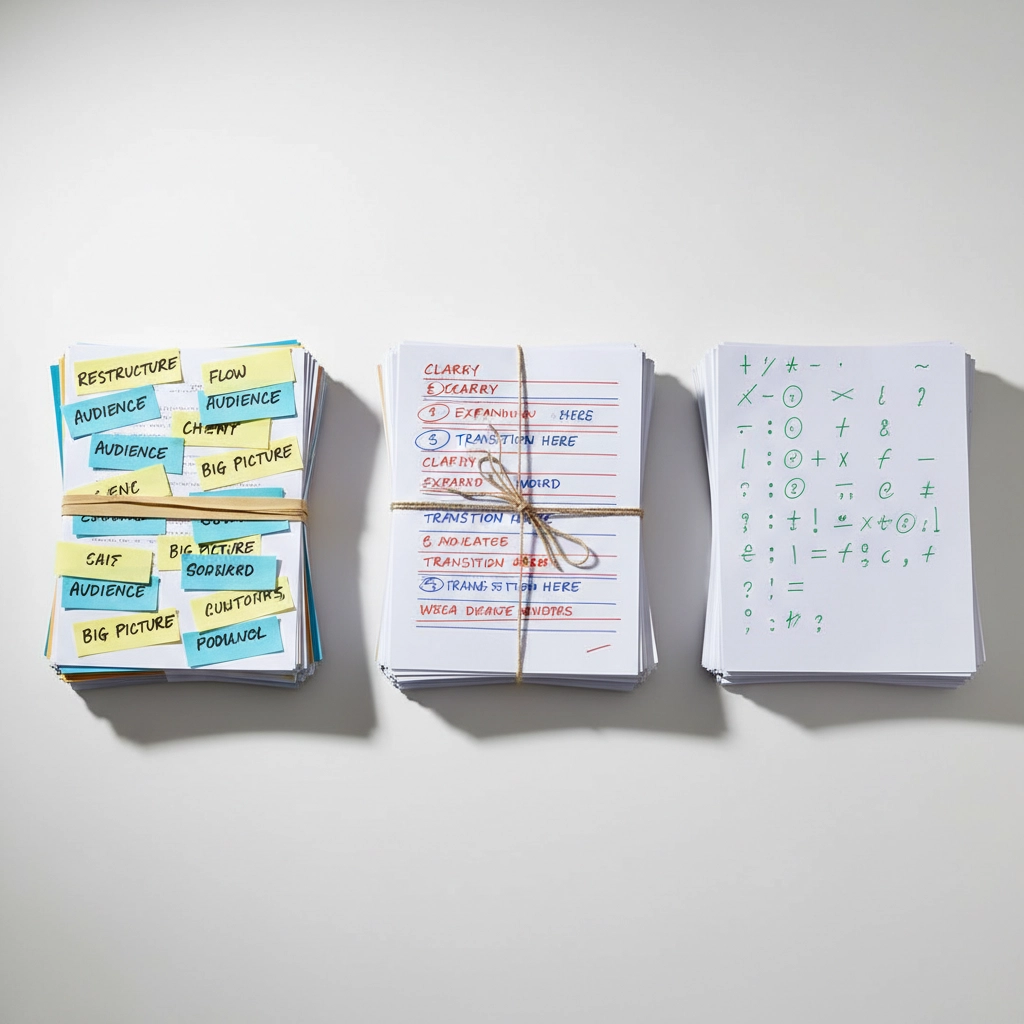
Conference presentations emphasize clarity and engagement over comprehensive detail. Edit for accessible language and compelling narrative structure that maintains audience attention during oral delivery.
Create document-specific checklists that reflect these priorities, ensuring your editing efforts address the most critical elements first. This targeted approach prevents perfectionism paralysis while optimizing time investment for maximum impact.
Hack 7: Establish Non-Negotiable Quality Standards
Professional editors maintain consistent quality standards regardless of time pressure or deadline constraints. Successful self-editors similarly establish minimum acceptable criteria that guide editing decisions and prevent premature submission of substandard work.
Define specific benchmarks for different quality dimensions. For example, require that every paragraph contains clear topic sentences, every claim includes appropriate supporting evidence, and every section transition explicitly connects to overarching arguments.
Establish error tolerance thresholds for different document stages. First drafts might tolerate higher error rates while focusing on content development, but final submissions require comprehensive accuracy across all dimensions.
Create accountability systems that enforce these standards. Share drafts with trusted colleagues, use professional editing services for high-stakes submissions, or maintain personal editing logs that track improvement over time. External accountability prevents the rationalization that often leads to premature submission of inadequately edited work.
Transform Your Academic Writing Today
These seven professional editing hacks represent systematic approaches that convert time-consuming editing struggles into efficient, results-driven processes. By implementing targeted error detection, strategic cognitive breaks, systematic reading techniques, phased editing approaches, balanced technology use, document-specific priorities, and consistent quality standards, you will dramatically improve both editing efficiency and final document quality.
Remember that effective self-editing requires practice and refinement. Start by implementing one or two techniques, master those approaches, then gradually incorporate additional strategies into your workflow. The investment in developing systematic editing skills pays dividends across your entire academic career.
When facing particularly challenging documents or tight deadlines, consider professional editing support to ensure optimal results. Expert editors provide objective evaluation and specialized knowledge that complement your self-editing efforts, particularly for high-stakes submissions like dissertation defenses or journal publications.
Ready to elevate your academic writing to professional standards? Submit Your Document today and discover how expert editing support can transform your scholarly work.


0 Comments